
Admiralen-class destroyers
| In the 1920s, the Dutch evaluated various European designs to replace the obsolete destroyers of the Roofdier-class. They settled for the British design of HMS Ambuscade. This type included many hard-learnt lessons from the Great War. The design was altered in places to make them more suitable for service in the Netherlands East Indies: a floatplane was added, and the fire control system was considered better than that of their British counterparts. The famous British destroyer yard Yarrow & Co. Ltd from Glasgow made these alterations to the design. During World War 2, these destroyers were in need of a modernization. Their anti-aircraft armament was rapidly becoming obsolete, and their means to detect and destroy submarines were minimal. Between 1940-1942, two of the destroyers had their aft masts removed; Van Ghent and Witte de With received asdic, but otherwise, these ships differed little from their original configuration at the time of their loss. |
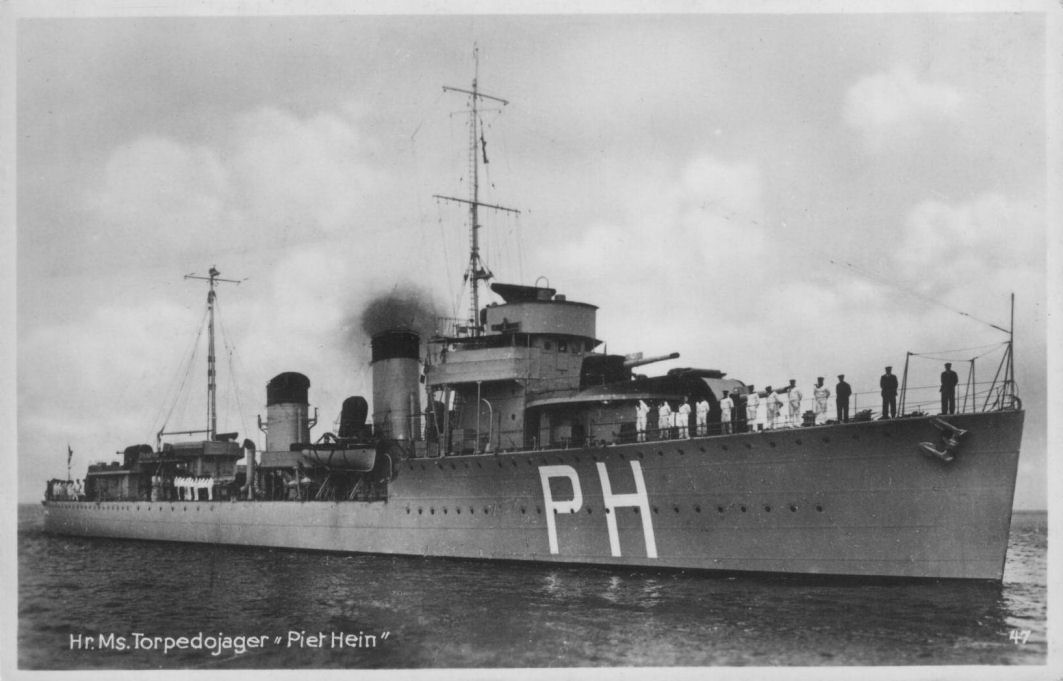 |
Piet Hein, date and place unknown (Collection O. van Hoften) |
| Construction details (1st group) | ||||
| Evertsen | Piet Hein | Van Ghent ex-De Ruyter* |
Kortenaer | |
| Dockyard | Burgerhout ** | Burgerhout | Schelde *** | Burgerhout |
| Dockyard number | 179 | |||
| Laid down | August 5, 1925 | August 26, 1925 | August 28, 1925 | August 24, 1925 |
| Launched | December 29, 1926 | April 2, 1927 | October 23, 1926 | June 30, 1927 |
| Completed | April 12, 1928 | January 25, 1928 | May 31, 1928 | September 3, 1928 |
| Pennants | EV | PH | DR (GT) | KN |
| Construction details (2nd group) | ||||
| Van Galen | Witte de With | Banckert | Van Nes | |
| Dockyard | Wilton-Fijenoord**** | Wilton-Fijenoord | Burgerhout | Burgerhout |
| Dockyard number | 307 | 308 | ||
| Laid down | May 28, 1927 | May 28, 1927 | August 15, 1928 | August 15, 1928 |
| Launched | June 28, 1928 | September 11, 1928 | November 14, 1929 | March 20, 1930 |
| Completed | October 22, 1929 | February 20, 1930 | November 14, 1930 | March 12, 1931 |
| Pennants | VG | WW | BK | VN |
| * De Ruyter was renamed to Van Ghent in 1934 to allow a new cruiser to take this name. ** Dockyard's name in full: Burgerhout's Scheepswerf en Machinefabriek, Rotterdam *** Dockyard's name in full: Koninklijke Mij "De Schelde", Vlissingen (Flushing) **** The Van Galen and Witte de With were originally ordered at the Mij. Fijenoord dockyard in Rotterdam, but this company merged with Wilton, Schiedam in 1929. The new name Wilton-Fijenoord was used for all ships completed in 1929. |
||||
| Specifications | ||||
| Van Ghent Evertsen |
Piet Hein Kortenaer |
Van Galen Witte de With |
Banckert Van Nes |
|
| Displacement | 1316 tons Washington displacement 1640 tons full load |
|||
| Dimensions | 98,1 (oa) 93,4 (pp)x 9,5 x 3,0 m | |||
| Crew | 149 | |||
| Armament | 4 x 120 mm Siderius No.4 2 x 75 mm No.6 4 x 12.7 mm Browning |
4 x 120 mm Siderius No.4 2 x 75 mm No.6 4 x 12.7 mm Browning |
4 x 120 mm Siderius No.4 1 x 75 mm No.7 4 x 40 mm No.1 4 x 12.7 mm Browning |
4 x 120 mm Siderius No.5 1 x 75 mm No.8 4 x 40 mm No.1 4 x .50 Browning MG |
| Torpedoes | 6 x 53,3 cm (21") torpedolaunchers with Whitehead type II 53 torpedoes. | |||
| Other | 1 floatplane* 24 Vickers mines on 2 minerails |
|||
| ASW | 4 depthchargethrowers with 12 charges Asdic ** |
|||
| * By World War II, it appears that the floatplane was no longer used in operations ** British type, only for Van Ghent and Witte de With. These were fitted in 1941-1942. Do you know which type? Please contact me. |
||||
| Propulsion details | |
| Boilers | 3 Yarrow* |
| Machinery | 2 sets of Parsons geared turbines |
| Shafts | 2 |
| Range | 3300 nautical miles @ 15 knots |
| Bunkerage | 305 metric tons oil (1st group) 330 metric tons oil (2nd group) |
| Performance | 31000 shp |
| Max speed | 34 knots |
| * The two groups differed slightly in this respect. The first group had boilers with an operating pressure of 17 kg/cm2, the second 25,2 kg/cm2. | |
| Histories | |
| Evertsen | Deployed as convoy escort during 1940-1942. In February 1942, she became part of the Western Striking Force, a squadron of Allied ships based at Batavia. During its last sortie in the night of February 27 and 28, it became seperated from the main force, after which she returned to her base on the 28th. During the following night, she was ordered to escape to Colombo via Sunda Strait, but the ship was intercepted by the Japanese destroyers Murakumo and Shirakumo en route. Several hits caused a large fire, after which the captain saw no other option than to beach his ship on the reef Seboekoe Besar. Nine men were killed, the others were captured and imprisoned for the duration of the war. |
| Piet Hein | In the night of February 19 and 20, she was part of the Allied force which tried to destroy the Japanese invasion forces at Bali. During the following gunfight, she was hit by shells and several torpedoes, after which she sank with the loss of 64 crew. More information here |
| Van Ghent | In action off Kangean against Japanese bombers on February 4, 1942. Took part in the Allied sortie against the invasion convoy for Palembang on February 15, but during the squadron's transit through Stolze Strait, she was accidentally beached on the Bamidjo reef between Banka and Billiton island. Position 03.05 S-107.21 E. No casualties, the entire crew was taken off by Banckert. |
| Kortenaer | Took part in the Allied sortie against the invasion convoy for Palembang on February 15, and escaped unharmed. Also took part in the Battle of the Java Sea, during which she was hit by a Japanese torpedo, reportedly from the Japanese heavy cruiser Haguro, which broke her back in position 06.29 S-112.05 E. 56 or 59 of a crew of about 150 were killed. The wreck of Kortenaer was discovered in 2004 by an Australian diving team, which originally had set out to find HMS Exeter. More information under "Related links". |
| Van Galen | In service in the Netherlands East Indies until 1939, when she was recalled to Holland. Arrived in Den Helder on May 8, 1940. On May 10, the Germans invaded the Netherlandes. On the same day, Van Galen was ordered to steam to Rotterdam to bombard the German forces at the captured airfield Waalhaven with her main battery. While still en route, she was attacked by German aircraft, which damaged her. She made it to the Merwehaven, where she sank. Raised by the Germans on October 23, 1941, and scrapped in Hendrik-Ido-Ambacht. |
| Witte de With | Took part in the Battle of the Java Sea (February 27-28, 1942); escorted the British heavy cruiser HMS Exeter to Soerabaja after she had been damaged by Japanese shells. Witte de With was damaged by a Japanese bomb hitting the fo'c'scle on March 1, 1942. She was then scuttled on March 2. No casualties. |
| Banckert | In action off Kangean against Japanese bombers on February 4, 1942. Took part in the Allied sortie against the invasion convoy for Palembang on February 15, during which she evacuated the crew of her sistership Van Ghent. Damaged by Japanese aerial attacks on February 24 and 28, 1942, after which she was scuttled on March 2. Raised by the Japanese, who intended to commission her as Patrol boat 106, but the repairs were never completed. Found in damaged condition after the war and sunk as targetship during gunnery excercises in Madura Strait, September, 1949 |
| Van Nes | Escorted the Dutch passengership Sloet van de Beele, which carried a detachment of troops from Billiton for Batavia. Attacked and sunk by Japanese aircraft from the Japanese carrier Ryujo in position 03.27 S-106.38 E, February 17, 1942, with the loss of 68 crew. |
Sources and related links |
|
|
Sources A.J. Vermeulen "De schepen van de Koninklijke Marine en die der gouvernementsmarine 1814-1962 (1962) Chr. Mark "Schepen van de Koninklijke Marine in W.O. II" (1997) J.M. Mohrmann "Marine-torpedodienst 1875-2000" (2000) M.A. Cageling/P. de Jong "Onze strijdmacht ter zee" (1938) M.J. Whitley "Zerstörer im Zweiten Weltkrieg - Technik, Klassen, Typen" (1997) "De schepen die wij bouwden 1875-1950 (history of Koninklijke Mij. "de Schelde")(1950) Jaarboek van de Koninklijke Marine 1929-1930 Jaarboek van de Koninklijke Marine 1930-1931 Related links (please report any broken links) Admiralen-class photo special (internal link) Battle of Badung Strait - Loss of Hr.Ms. Piet Hein (internal link) Prop 'n Turret discussion forum (discussion on history of Patrol Boat 106 (ex-Hr.Ms. Banckert) |
|
| February 4, 2011 | Added link to photos of Evertsen's wreck |
| May 31, 2006 | Complete revision of page |
| Back | Home |